Cotton in conversion
Consumers are increasingly concerned about the environmental impact of textiles, and that’s a positive development. However, major industry players have noticed this shift and are quickly jumping on the bandwagon: the race for organic cotton is officially underway.
This surge in demand is disrupting the organic cotton market: what was once comparable in price to conventional cotton is now seeing prices rise rapidly (even more so than we do after the holiday season!).
As a result, organic cotton prices have now surpassed those of regular cotton. This is a logical outcome, as organic cotton farming still carries higher costs for farmers.
But when demand exceeds supply, problems arise.
That’s exactly why Patagonia took the initiative to introduce “in-conversion cotton” in 2020. The concept? To support the transition to organic cotton by offering fair prices for textiles made from fields that are in the process of being converted from conventional to organic farming.
So how does this work?
To convert a field to organic farming, the farmer must follow a series of steps…
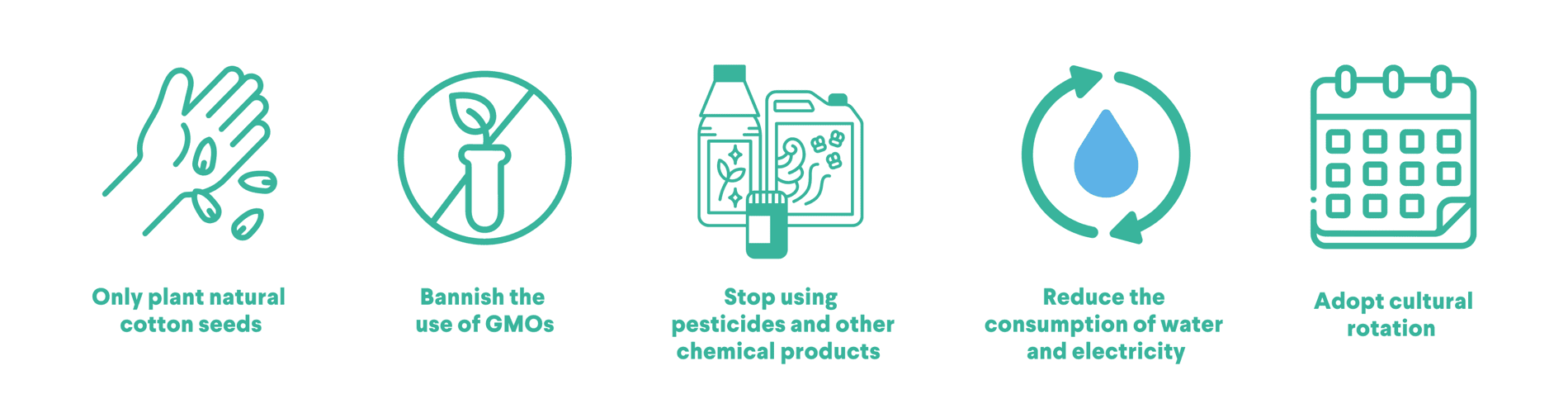
Let’s agree on this: these newly converted fields must meet the same stringent requirements as fully certified organic cotton.
However, it can take up to three years for these fields to earn their organic certification, and it is this certification that ensures farmers receive fair compensation for their efforts in transitioning to more sustainable farming methods.
That’s where in-conversion cotton comes in: it’s cotton that isn’t officially certified organic but meets all the standards required for organic cotton. Despite not having certification, it’s still a valuable resource.
Why choose in-conversion cotton?
For the planet
In-conversion cotton farming is significantly more environmentally friendly than the majority of conventional cotton fields worldwide. With no harmful chemicals and reduced water and energy consumption, it stands as a sustainable agricultural model, on par with organic cotton. As advocates of a healthier planet, we can only support this approach.
For ethical reasons
The transition from conventional to organic cotton comes at a cost for farmers. Without the use of chemicals that typically enrich the soil, crop yields drop significantly during the first few years of conversion. Without fair compensation, this transition can be an overwhelming challenge for farmers.
Supporting the sale of in-conversion cotton is a way to honor and reward the farmers who are striving to make the textile industry more sustainable. They deserve our support.
To prevent organic cotton prices from rising
Without in-conversion cotton, there can be no organic cotton. Without organic cotton, the demand remains unfulfilled. And without supply meeting demand, organic cotton prices will continue to soar.
The three-year transition period may not seem appealing to farmers at first – understandably so. This period could discourage them from making the switch and slow the global adoption of organic cotton. With demand for organic cotton projected to grow by 84% by 2030, losing willing farmers would significantly hinder market growth.
Between June 2021 and early 2022, the price of organic cotton surged by a staggering 50%. To prevent this trend from continuing – gradually but surely – it’s crucial to support farmers who are willing to transition to organic farming. This requires fair compensation, a principle that, while obvious, only became feasible with the introduction of in-conversion cotton in 2020.